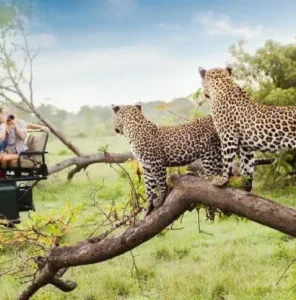
Leopards on the rocks
Around sixty in the area. Morning and evening drives, with guides who know individual animals by territory and by name.
Wildlife
Granite hills where leopards and Rabari herders have shared ground for generations, a hundred and seventy kilometres from Udaipur. Two days from ₹6,000 for the car.
Overview
Jawai is not a national park. It is a landscape of ancient granite outcrops and scrub around the Jawai Bandh dam in Pali district, where a population of leopards lives among Rabari herders and their goats, in caves above villages, with no boundary wall and almost no recorded conflict. It is one of the genuinely unusual wildlife situations in India.
Sightings are good — better than most tiger reserves — because the hills are open, the animals are habituated to vehicles, and the guides know individual leopards by name and by territory. Safaris run at dawn and in the late afternoon in open jeeps, and the light on the granite at either end of the day is half the reason to be there.
It is a hundred and seventy kilometres from Udaipur, about three and a half hours. One night and two safaris is the minimum that makes sense; two nights is better. Camps range from simple to extremely luxurious, and we can book across that range.
Fares
Transport only. Safari fees and camp stays are separate and booked directly with the property or through us.
| Trip | Sedan | Innova Crysta | Tempo Traveller 17 | Distance |
|---|---|---|---|---|
| One-way drop at Jawai | ₹3,200 | ₹3,800 | ₹7,500 | 170 km |
| 2 days / 1 night | ₹6,000 | ₹7,200 | ₹13,500 | 340 km round |
| 3 days / 2 nights | ₹8,000 | ₹9,500 | On request | With Ranakpur |
| Jawai + Ranakpur + Kumbhalgarh | ₹9,500 | ₹11,000 | On request | 4 days |
| Onward to Jodhpur | ₹5,500 | ₹6,500 | On request | Via Pali |
| Driver night allowance | ₹300 | ₹300 | ₹400 | Per night, included |
Highlights
Leopards are the headline. They are not the only reason to come.
Around sixty in the area. Morning and evening drives, with guides who know individual animals by territory and by name.
The dam and its reservoir — flamingos in winter, crocodiles year-round, and a lot of migratory birdlife.
The pastoral community whose grazing land this is. The coexistence with the leopards is centuries old and almost entirely peaceful.
Small temples in caves and on outcrops, some of which leopards use as daytime shelter. The proximity is not accidental.
Precambrian rock, some of the oldest exposed stone in India, and extraordinary in low light.
Jawai sits close to the Udaipur–Jodhpur road, so Ranakpur and Kumbhalgarh slot in naturally.
Jawai has gone from unknown to fashionable in about a decade, and the camps now range from modest tented setups to some of the most expensive rooms in India. The wildlife experience is broadly the same whichever you choose — the jeeps go to the same hills — so the decision is about comfort rather than sightings.
Two is the sensible minimum: one evening and one morning. Leopards are crepuscular and the light is best at both ends of the day. A single drive is a gamble; two makes a sighting likely; three or four across two nights makes it close to certain. Each drive lasts about three hours.
October to March is the window, with the best conditions from November to February — cool, clear and the reservoir full enough to bring in the birds. Summer is hot and the drives less pleasant, though sightings hold up. The monsoon closes much of it and the tracks become unusable.
A hundred and seventy kilometres from Udaipur via Gogunda and Sadri, about three and a half hours, on the same general axis as Ranakpur. That makes the natural itinerary Udaipur to Ranakpur to Jawai, and then either back to Udaipur or onward to Jodhpur, which is only a hundred and twenty kilometres further north. Several of our guests do exactly that as a four-day loop.
Enquiry
Tell us your dates and how many safaris you want, and whether you would like us to book the camp as well.
About a hundred and seventy kilometres via Gogunda and Sadri, three and a half hours. It sits on the same axis as Ranakpur, which makes combining the two natural.
Good — better than most tiger reserves. The hills are open, the animals are habituated to vehicles and the guides know individuals by territory. Two drives makes a sighting likely; three or four across two nights makes it close to certain.
No. Our fare covers the car from Udaipur and back. Safari jeeps are booked through the camp or a local operator, typically ₹3,500 to ₹6,000 per jeep per drive.
One night and two safaris is the minimum that makes sense. Two nights is noticeably better and lets you do a morning drive without rushing the drive home.
October to March, with November to February the pick — cool, clear, reservoir full and the birdlife in. The monsoon makes the tracks unusable.
It is the best way to do it. Udaipur to Ranakpur to Jawai, then either back or onward to Jodhpur, which is only a hundred and twenty kilometres further north. A four-day loop covers all of it.
Related services
Ready when you are
Same-day bookings, airport pickups at 3 AM, ten cars for a baraat — our booking desk stays open round the clock, all year.